
Fit check: This guide is for agencies and teams sending paid traffic to forms on their own websites, including local-service lead generation. Leads captured entirely inside Meta Instant Forms or Google-hosted lead forms do not create the website visits Whotrack observes.
For a PPC agency, “we have a bot problem” is the start of an investigation. It may describe automated visits, junk form submissions, a sudden reporting spike or a mismatch between clicks and sessions. Treating those observations as the same thing can lead to the wrong purchase or campaign change. First name the job you need done.
Bot traffic is broader than advertising fraud
Automation can visit a website for many reasons, including indexing, monitoring and malicious activity. A bot visit is therefore not automatically a fraudulent ad click. It might never have interacted with an advertisement at all. For advertisers, the useful question is whether an observed pattern affects campaign measurement, forms or genuine opportunities.
Google's invalid-traffic documentation covers interactions that do not reflect genuine interest, including nonhuman and accidental activity. Invalid traffic is broader than deliberate fraud, too. Google determines how its detection and adjustment process affects its own metrics and billing; a third-party classification does not make that decision.
A fake lead can come from a person
A nonexistent phone number, duplicate enquiry or out-of-area customer creates work for a sales team, but each suggests a different response. A real person can enter false details. A genuine enquiry may be outside the service area. An automated visit might submit nothing.
Google's invalid-lead guidance separates lead safeguards from ad-traffic protection. Keep a CRM outcome such as qualified, rejected or unresolved alongside the website label. Do not turn inferred human into confirmed buyer, or unknown into bot. For a campaign-specific investigation, use the Performance Max audit or Search Partners review.
What bot traffic analytics adds
Whotrack labels each observed visit inferred human, inferred bot or unknown and shows the evidence behind that result. Source, channel and campaign breakdowns retain the three-way split, and conversions keep the label of the visit behind them. This helps an agency locate patterns and explain what needs investigation.
The label remains an inference. Some automated activity can resemble a person, while an unusual human setup can produce ambiguous evidence. Unknown means the available evidence is insufficient. It is a category to inspect and report, not a hidden pool of confirmed bots.
The collection scope also matters. Whotrack sees activity on connected websites. It cannot label leads from Meta Instant Forms or Google-hosted lead forms that never load the customer's site. Review the label definitions and the documented limits before promising a client complete coverage.
What analytics and blocking each do
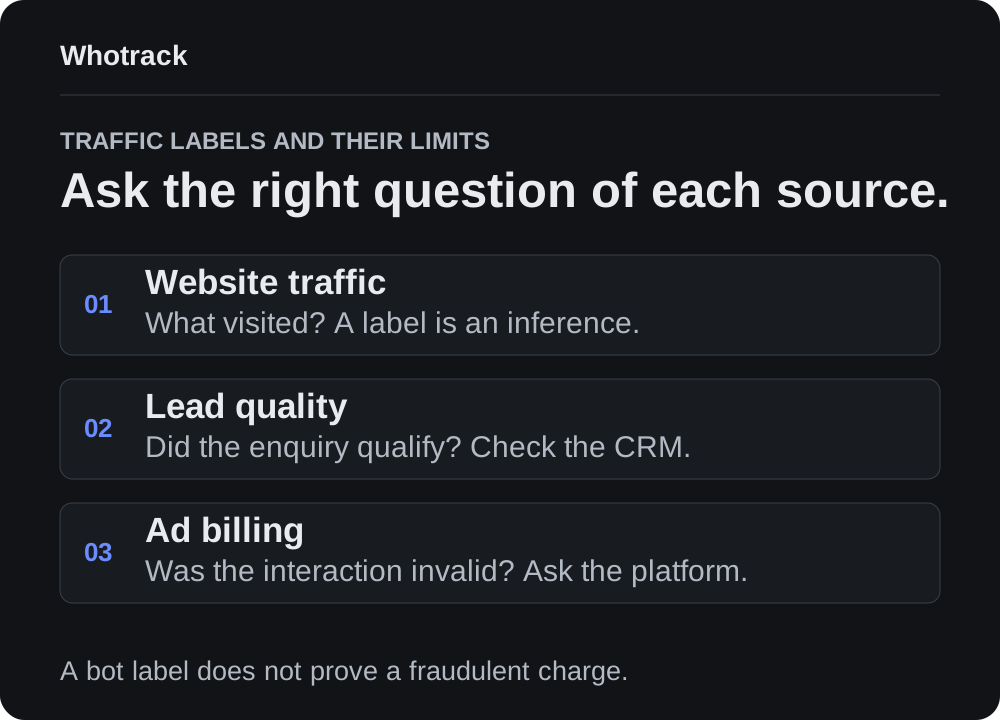
Use the task rather than the product category to decide what is missing. An analytics report helps observe and investigate activity. A form safeguard checks submissions. A prevention control changes whether traffic or an interaction is permitted. A sales review determines business fit. One workflow can need several of these.
| Question | Useful evidence | What it does not establish |
|---|---|---|
| What visited the site? | Visit records, labels and their reasons | A verified person or fraudulent ad charge |
| Was the form valid? | Validation results and duplicate checks | A commercially qualified buyer |
| Did the lead qualify? | Contact attempts and CRM outcome | Whether the visit was automated |
| Should traffic be restricted? | The relevant protection or platform control | A complete explanation of past leads |
| Was billing invalid? | Ad-platform investigation and records | A conclusion from bot share alone |
Whotrack supplies traffic classification and reporting. It does not block clicks or push IP exclusions to Google or Meta. If prevention is the immediate requirement, evaluate the actual controls and their scope separately. Do not buy an evidence report expecting it to operate as an automatic blocker.
Why the totals can disagree with GA4
Google Analytics automatically excludes known bot and spider traffic. Google says this exclusion cannot be switched off and does not show an amount removed. That is not a claim that every automated visitor disappears from GA4.
Two analytics systems can differ because of what they collect, what they classify and what prevents their collection. Google also documents differences between ad clicks and analytics sessions, including tracking and filtering effects. A mismatch is a reason to examine measurement, not proof that someone stole the difference.
Keep the denominator and uncertainty in the report
State whether a percentage refers to visits, events, conversions or reviewed leads. An illustrative sample of 100 visits might contain 60 inferred human, 25 inferred bot and 15 unknown. The inferred-bot share is 25%, and 15% remains unresolved. These invented figures explain the denominator; they are not a Whotrack benchmark.
That 25% does not mean 25% of ad spend was wasted. Website visits and billed ad interactions have different scopes, and some invalid activity may already be filtered by the platform. Likewise, a form-event count is not a qualified-lead count.
Start with one repeatable review
Choose a campaign and date range. Save its website label mix, inspect a consistent set of converting visits, and ask the sales team to apply explicit qualification reasons to the corresponding enquiries where reliable matching is possible. Note incomplete matches rather than forcing them. Revisit the same measures after a documented change.
Use the installation guide to connect a website and consistent campaign tags to keep reports interpretable. Whotrack's plans include a seven-day card-required trial. The useful result is a checkable record for better decisions, not a claim that every suspicious visit has been prevented or refunded.
What to tell the client
Keep the claim narrow: “These are inferred traffic labels with evidence, not verified identities or a refund calculation. We will compare the pattern with lead outcomes and the platform's records.” This makes uncertainty visible without discarding useful signals.