
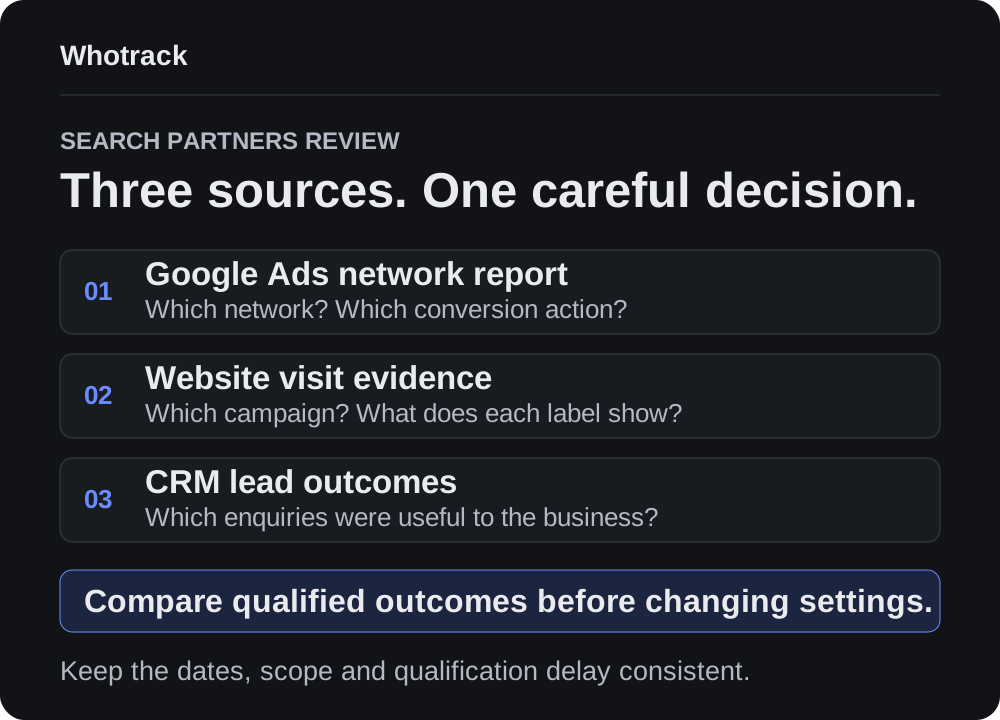
Fit check: This guide is for agencies and teams sending paid traffic to forms on their own websites, including local-service lead generation. Leads captured entirely inside Meta Instant Forms or Google-hosted lead forms do not create the website visits Whotrack observes.
A client may describe every unreachable contact as a fake lead. That is a useful warning, but it is not yet a diagnosis of Search Partners. Start with the campaign type, the network breakdown and the sales outcome. The aim is to find whether a specific source produces useful business, not to prove a suspicion from one unusual session.
Confirm which campaign you are reviewing
For Google Search campaigns, Google's Search Network documentation says Search Partners are included by default and can be deselected in the campaign's Networks settings. Check the actual campaign rather than assuming an old screenshot matches its current configuration.
Performance Max is a different campaign type with its own controls. Do not promise that the same Search campaign checkbox disables partner exposure there. If the problem comes from Performance Max, use the Performance Max quality-audit workflow and its linked official guidance instead.
Also confirm where the lead form lives. Whotrack observes visits and events on a customer's own website. An enquiry collected wholly inside Meta Instant Forms or Google-hosted lead forms is outside that website dataset. A report should state this boundary before comparing totals.
Separate networks before comparing conversion costs
In Google Ads, use the available Network with search partners segmentation to compare the relevant rows. Check which metrics the selected campaign and table support. Keep dates, timezone and conversion-action definitions consistent.
Then ask what a conversion means. A low cost per form fill may look attractive while producing little work for the sales team. Compare the number of leads contacted, the number that qualified and the reasons others failed. Give recent enquiries enough time to move through the normal contact process; otherwise a newer network mix can appear worse merely because it has more unresolved leads.
Use placement reporting for exposure
Google's dedicated Search Partner full placement reporting guide describes site reporting for Search, Shopping and App campaigns through Content Suitability. Placements have inclusion thresholds, so the report is not an unrestricted record of every exposure. Use the current dedicated documentation rather than an old claim that partner domains can never be seen.
A site-level impressions report answers where exposure occurred. It does not automatically identify the publisher responsible for each qualified or rejected lead. Keep those claims separate in a client presentation. For Performance Max, placement reporting has its own scope and should not be treated as a complete campaign-performance report.
Bring website labels into the investigation carefully
Whotrack groups recorded visits by source, channel and campaign and shows their human, bot and unknown split. It also preserves the evidence behind each inferred label. That can reveal a campaign worth examining, particularly when the pattern repeats over several periods rather than appearing in one isolated visit.
Follow the campaign-tagging documentation so the values arriving on the website stay consistent. A campaign parameter tells you what was recorded; it does not independently verify the placement or network. The Google filter in Whotrack does not mean a visit came from Search Partners. Do not invent that connection from a generic referrer or a matching timestamp.
Keep unknown visits visible. An inferred human label is also not a qualification decision: a person can submit unsuitable or inaccurate details. The CRM's sales review and the website's traffic classification should remain separate columns.
Copy this network-review template
This is a blank reporting structure, not an example campaign result. Fill it from the client's actual systems and document any rows you cannot reliably reconcile.
| Evidence | Record | Limit |
|---|---|---|
| Google network row | Dates, network, cost and conversion action | Depends on campaign and report scope |
| Placement exposure | Reported sites and impressions | Not a lead-by-lead publisher match |
| Website pattern | Campaign, landing page and three visit labels | Not automatic network identification |
| Sales result | Contacted, qualified, rejected and unresolved | Allow the usual qualification delay |
| Decision | Change, scope, owner and review date | State other changes during the test |
Test a change without hiding useful volume
If the evidence supports testing Search Partners off in a Search campaign, save the baseline and settings first. Agree on a review window and success measure. Keep other material changes limited where practical, and record those that are unavoidable.
Compare qualified lead count and cost per qualified lead, not just the share of unwanted forms. Turning off a source may reduce junk and useful enquiries together. A lower rejection percentage is incomplete without the volume and commercial value that remain. A before-and-after change is still observational when seasonality, bidding or demand also moved.
Keep billing complaints separate
Google's invalid-traffic guidance distinguishes its billing checks from third-party reports. A visit your analytics flags may overlap traffic already filtered by Google. A low-quality lead does not, by itself, establish a chargeable invalid click.
Whotrack does not block clicks or push IP exclusions. Its reports are evidence for a traffic-quality review, not a guarantee of a refund. Read what bot analytics can prove, then review the label definitions. The seven-day trial requires a card; use it to inspect your own website traffic alongside the platform and CRM records.
What to tell the client
Use a conclusion the evidence supports: “We are comparing network-level results with qualified outcomes. The website report helps locate suspicious campaign patterns; it does not identify every Search Partner publisher.” Agree on a test and review date, and report useful lead volume alongside quality.