
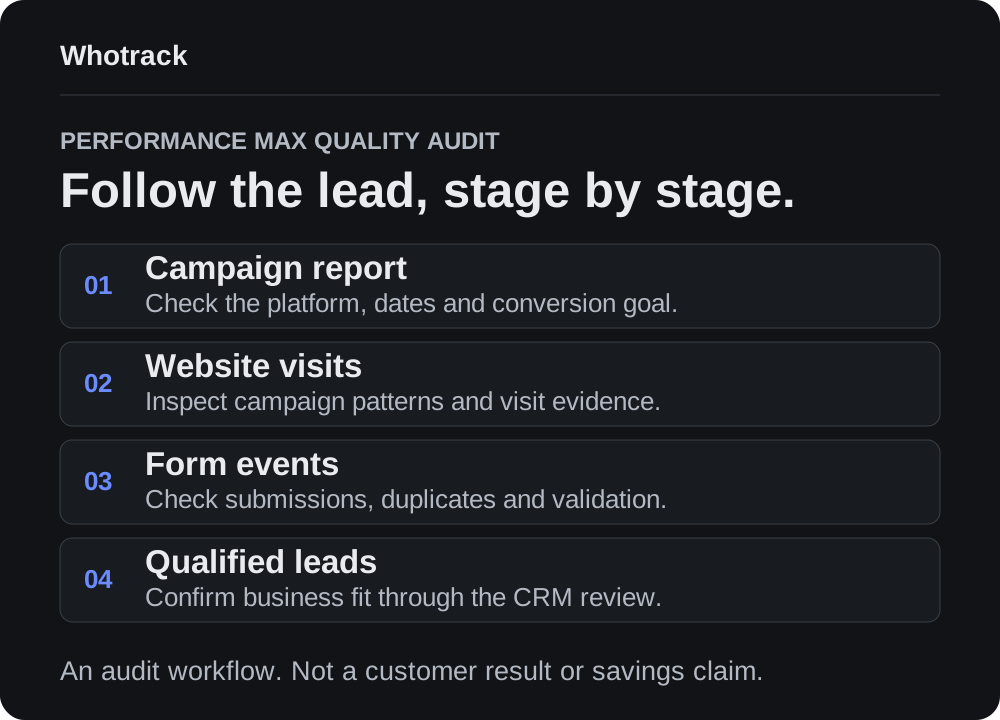
Fit check: This guide is for agencies and teams sending paid traffic to forms on their own websites, including local-service lead generation. Leads captured entirely inside Meta Instant Forms or Google-hosted lead forms do not create the website visits Whotrack observes.
If a client's campaign reports more conversions while the sales team reports fewer useful enquiries, first agree on what each system counts. Performance Max brings together several advertising channels, so a single campaign total can hide different audiences and outcomes. A useful audit separates measurement problems, poor fit, invalid contact details and suspected automation before choosing a fix.
Define the problem before calling it fraud
Ask the person handling enquiries to classify a fixed period of leads. Use categories they can apply consistently: genuine and qualified, genuine but unsuitable, duplicate, invalid contact details, and unresolved. Keep a brief reason for each decision. A customer outside the service area needs a different response from a form with a nonexistent phone number.
Google's invalid-lead guidance explains that invalid forms can still reach a website and that real people can submit incorrect details. Its advertising protections and your lead-validation process solve different problems. Do not assume every unwanted enquiry was submitted by a bot.
Check what the conversion action rewards
Write down the campaign's current primary conversion actions and where they fire. Does the recorded action mean a completed form, a click on a contact button, a phone call, or a qualified opportunity? Confirm that a refresh or repeated event does not create another apparent success.
Google recommends aligning lead-generation goals with useful business outcomes, including qualified or converted leads where appropriate, in its high-quality lead guidance. A form submission can remain a useful early signal, but it should not silently become your definition of a sale-ready prospect. Check the underlying tracking and account configuration with the person responsible for them.
Build a campaign-quality review sheet
Choose a date range that gives the sales team time to contact people. Record its timezone and the normal qualification delay. Keep the same inclusion rules when comparing periods. The following blank template is a suggested working document, not a dataset or a performance benchmark.
| Record | What to enter | Source |
|---|---|---|
| Scope | Campaign, dates, timezone and landing page | Google Ads and website records |
| Lead totals | Form events, duplicates and contacted leads | Form system and CRM |
| Qualified outcomes | Qualified count and rejection reasons | Sales review in the CRM |
| Traffic labels | Inferred human, inferred bot and unknown visits | Whotrack with date filters |
| Next test | Evidence, one change, owner and review date | The agreed audit findings |
Keep aggregate comparisons separate from record-level matches. Similar times do not prove that a website visit and a CRM lead belong to the same person. Where your own systems provide a legitimate matching identifier, document how it works and who may access it.
Read campaign reports alongside website evidence
Review channel and placement information in Google Ads, then inspect the corresponding campaign and landing-page patterns on your website. Google's Performance Max placement report shows placement exposure and impressions. Google describes it as a brand-safety tool, not a complete performance report. A domain appearing there does not by itself show that it generated a particular bad lead.
Whotrack adds a separate view: visits labelled inferred human, inferred bot or unknown, with evidence for each, plus campaign and source breakdowns. The documented URL templates help keep campaign values consistent. Those values do not establish an exact Google placement, and Whotrack's Google filter is not a Search Partner identifier.
Preserve the unknown category. A visit without enough evidence is unresolved, not a bot by default. Likewise, a human label does not certify that the contact details are accurate or the person meets the client's buying criteria. The difference between traffic labels and click fraud matters when presenting the findings.
Choose the fix that matches the evidence
For out-of-area enquiries, review location settings and the intended audience. For invalid details, review form validation and qualifying questions. For irrelevant destinations, review the campaign's landing-page configuration. Google's Performance Max lead-generation recommendations cover these controls and other quality checks. Verify the settings available in the actual account before changing them.
Record the scope of an exclusion before applying it: some account-level changes affect other campaigns too. Do not copy a Search campaign's network opt-out instructions into Performance Max. The Search Partners guide explains that distinction.
Report qualified outcomes after the change
Change one documented issue where practical and note the date. Compare useful lead volume as well as cost per qualified lead, allowing for qualification delays and other campaign changes. Fewer form fills can be an improvement if useful opportunities remain steady; a cheaper form fill can be a worse outcome if nobody qualifies.
Do not multiply inferred bot share by ad spend and call the result money lost. Google may already have filtered some invalid interactions from billing, and a website classification is not a refund decision. Use Google's invalid-traffic process for billing investigations.
To add visit-level evidence to your review, read how Whotrack's labels work and compare the plans and seven-day card-required trial. Whotrack observes visits to your own website. It does not block clicks or label leads captured entirely inside Meta Instant Forms or Google-hosted lead forms.
What to tell the client
Separate what you observed from what still needs checking: “The campaign produced form events, but qualification is lower than expected. We are comparing the conversion setup, website evidence and CRM reasons before choosing a change.” State the scope and owner of the next test rather than labelling every rejected lead fraudulent.